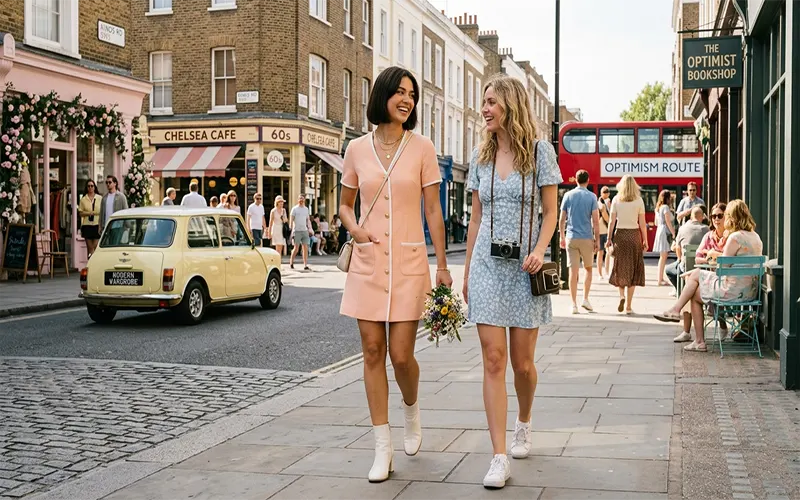
In the mid-1960s, a “Youthquake” rattled the foundations of the fashion world. The rigid, corseted silhouettes of the post-war era were abruptly swept aside by a geometric revolution led by visionaries like Mary Quant and André Courrèges. The centerpiece of this rebellion was the A-line mini dress. Today, in the spring of 2026, this iconic silhouette is experiencing a profound resurgence. However, this isn’t a mere exercise in nostalgia; it is a reclamation of “Space Age” optimism, rendered in a palette of soft pastels and engineered with modern, sustainable precision.
For the contemporary woman, the A-line mini represents more than just a hemline. It is a sartorial declaration of movement, clarity, and a “future-forward” mindset that feels essential in our rapidly evolving landscape.
The Geometry of the A-Line: Precision in Motion
The A-line dress is a masterpiece of architectural simplicity. Narrow at the shoulders and gently flaring out toward the hem, it creates a literal “A” shape that skims the body without clinging to it. This design was revolutionary because it prioritized the wearer’s ability to move, dance, and navigate the city—a stark contrast to the restrictive “wiggle” dresses that preceded it.
The Technical Construction
To achieve the perfect 1960s profile in 2026, the construction must be rigorous.
- Fabric “Heft”: The silhouette relies on fabrics with structural integrity. Double-knit wool, heavy crepe, or high-density recycled synthetics ensure the triangular shape holds its form even while the wearer is in motion.
- The Stand-Away Collar: A hallmark of “Mod” design, these collars sit slightly away from the neck, providing a sharp, graphic frame for the face.
- The Architecture of Darts: Subtle bust and back darts are used not to tighten the fit, but to provide just enough shape to ensure the dress looks tailored rather than shapeless.
Designer Spotlight: The Visionaries
“The mini dress was not a fashion; it was a way of life,” Mary Quant famously noted. While Quant democratized the look in London’s King’s Road boutiques, André Courrèges brought a “Space Age” technicality to it in Paris, using white and silver piping to emphasize the geometric lines. Their influence remains the blueprint for the 2026 revival.
The Pastel Palette: The Language of “Soft Power”
In 2026, the return to 1960s pastels is a psychological pivot. After years of utilitarian grays and tech-blacks, colors like Pistachio, Lemon Sherbet, Powder Blue, and Lavender offer a sense of renewed hope and professional “Soft Power.”
These colors communicate a high level of confidence. Wearing a sharp, geometric dress in a soft Lavender or a cool Mint Green suggests an individual who is secure in her authority and doesn’t feel the need to rely on the traditional “power colors” of black or navy. In professional settings, these pastels act as a visual palate cleanser, projecting an image of clarity and approachable leadership.
60s Silhouette vs. Modern Fit: The 2026 Update
While the aesthetic is retro, the engineering is entirely modern. The 2026 version solves the practical issues that plagued the original 1960s designs.
| Feature | Original 1960s Mod | 2026 Retro-Revival |
| Hemline Stability | Prone to “riding up” due to light fabrics. | Weighted hems and internal grips for stability. |
| Sustainability | Often made of non-breathable, virgin polyester. | Recycled, bio-based synthetics and organic wool. |
| Functionality | Rare to find pockets; focus was on line. | Deep, reinforced internal pockets for tech. |
| Fit | Often “one size fits many” / boxy. | Precision-tailored to accommodate diverse body types. |
The Utility of the Mini: Functional Pockets & Tech Integration
For Nisa and the modern professional, a garment’s value is measured by its utility. One of the most significant updates to the 2026 A-line mini is the integration of functional pockets.
Historically, the mini dress was criticized for its lack of practicality. Designers in 2026 have corrected this by utilizing the “A” flare of the skirt to house deep, reinforced side-seam pockets. Because the fabric has enough “heft,” these pockets can hold a smartphone or a digital cardholder without causing the fabric to sag or distorting the clean geometric line. Furthermore, the structured lining of these dresses is increasingly used to house “discreet wearables”—subtle haptic or health-tracking tech—ensuring that the dress is as smart as it is stylish.
Styling the 2026 “Mod”
The versatility of the A-line mini allows it to transition from a high-authority office environment to a creative social space with ease.
1. The “Go-Go” Influence
For a weekend gallery opening, embrace the heritage. Pair a Pistachio A-line mini with white patent leather knee-high boots and graphic, oversized jewelry. This look leans into the playfulness of the era while remaining firmly modern through clean, minimalist accessories.
2. The “Workwear” Pivot
To make the mini office-appropriate, focus on layering. Wear a thin, tonal turtleneck (e.g., a darker Lavender under a pale Lavender dress) to provide more coverage. Pair with opaque tights and a structured pointed-toe flat. When leaving the office, layer a sharp, oversized trench coat in a neutral camel to ground the pastel tones.
Sustainability & Textile Innovation
The 1960s were famously the “Age of Plastics,” characterized by disposable paper dresses and cheap polyester. The 2026 revival takes the opposite approach.
The industry is moving toward Infinite Recyclability. High-end mod fabrics are now being produced from fiber-to-fiber recycled synthetics that mimic the “bouncy” feel of 60s jersey but with a carbon-neutral footprint. By choosing a silhouette that is inherently “slow fashion”—the A-line hasn’t gone out of style in 60 years—the wearer is making a commitment to a circular wardrobe. These dresses are built to last, designed with generous seams for future tailoring, and made from materials that can eventually be returned to the production cycle.
Future-Forward Playfulness
The 1960s A-line mini dress in pastel colors is more than a trend; it is a sartorial celebration of a future that is bright, clear, and mobile. It allows the modern woman to move through her day with a sense of “future-forward” playfulness, reclaiming the optimism of the Space Age for a world that requires both resilience and imagination.
By choosing this silhouette, you are embracing a piece of history that was designed to break barriers. In its sharp lines and soft colors, you find a balance of authority and approachable grace—proving that the most powerful thing you can wear is a sense of your own agency, wrapped in a classic geometric frame.